JioSaavn vs. Gaana: A Comparison of India’s Music Streaming Platforms
JioSaavn vs. Gaana: freemium vs. subscription-only, 16% vs. 11% reach. Comparing India’s platforms and what it means for labels and distributors.

JioSaavn vs. Gaana: freemium vs. subscription-only, 16% vs. 11% reach. Comparing India’s platforms and what it means for labels and distributors.
India is already the world’s third largest music streaming market by volume, and still one of the least monetized. That is the context in which any JioSaavn vs. Gaana comparison makes sense. Luminate counted more than 218 billion official on demand streams (audio and video) in India in H1 2026, and about 80% of that volume was ad supported. EY and IMI found that 96% of smartphone owners listen to music, yet only around 14 million paid subscriptions existed at the end of 2025, roughly 8% of the 178 million people streaming music online. IFPI ranks India as the 14th largest recorded music market, a lag between revenue and listenership that its CEO has called out directly.
That gap frames how the two platforms should be read. The two services are often presented as direct rivals, yet they sit at different points on the monetization spectrum: JioSaavn is a freemium service inside the Jio ecosystem, while Gaana is a subscription only service operated by the Times Group. Neither is the most used destination for Indian listeners. In the EY and IMI survey, YouTube (32%) and Spotify (31%) reached more respondents than JioSaavn (16%) or Gaana (11%), and the report found that listeners move between platforms by use case rather than by loyalty.
For labels and distributors, the useful question is therefore what each service contributes to a catalogue strategy for India, and what it takes to serve all of them well.
JioSaavn was founded in 2007 and operates within Jio's digital ecosystem, which is controlled by Reliance Industries. The company reports more than 100 million monthly active users. Its catalogue exceeds 100 million tracks across 16+ languages and includes podcasts as well as music.
The service runs on a freemium model. Listeners can use an ad supported tier or subscribe to JioSaavn Pro, which removes ads and adds unlimited downloads, unlimited skips and JioTunes, the caller tune product available to Jio users.
Gaana launched in 2010 and has been operated since December 2023 by Entertainment Network (India) Limited (ENIL), the listed Times Group company best known for Radio Mirchi. ENIL management describes Gaana as a pure subscription business: the service went behind a paywall under its ownership, it has no free customers, and its paid base has grown at around 15% a year over the last two years.
On product, Gaana's own App Store listing cites 30 million+ songs in 20+ languages, with Hindi, Tamil, Telugu, Punjabi, Kannada and Bhojpuri among those named, plus podcasts.
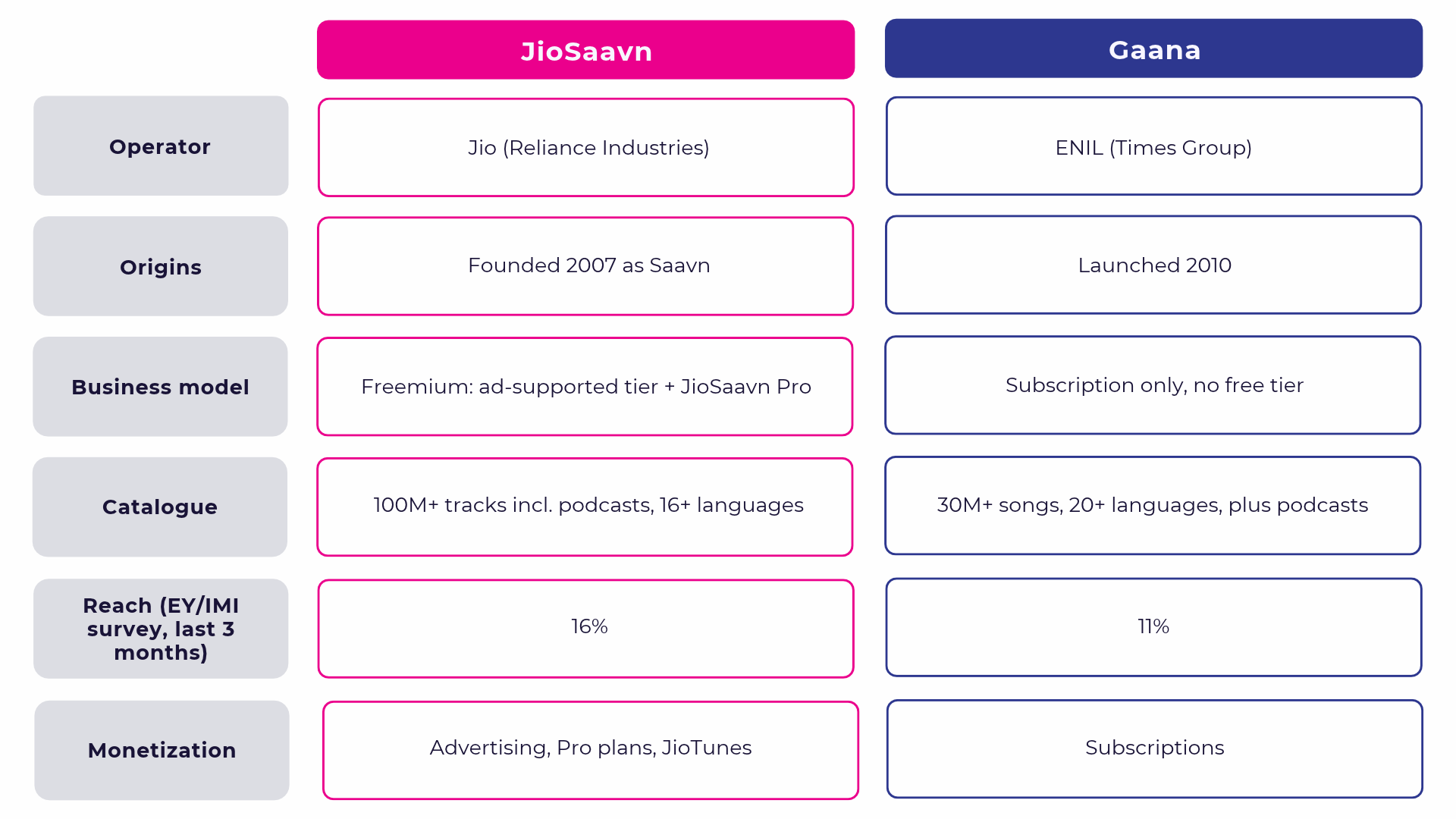
The clearest difference is the business model. JioSaavn combines a free, ad-supported tier with paid Pro plans and sits inside the Jio ecosystem, while Gaana has removed its free tier entirely, so every listener is a paying subscriber.
That shapes how each service grows. JioSaavn grows by converting a large free audience into paying users, while Gaana grows by adding subscribers directly, a base ENIL reports has expanded at around 15% a year. Neither publishes subscriber numbers, so the size of their paid bases cannot be compared.
Both services organise discovery around language and carry deep catalogues of Indian repertoire, including regional music. Their catalogue figures are not directly comparable, since each company counts content differently and JioSaavn’s includes podcasts. For rights holders, the more relevant question is whether each release is correctly delivered and tagged on both.
Placed alongside Spotify, YouTube, Amazon Music and Apple Music, JioSaavn and Gaana look less like a two horse race and more like two components of a wider ecosystem. The EY and IMI survey gives the clearest picture of how that ecosystem is used.
Share of respondents who used each service in the last 3 months:
The data above shows that among 15,373 smartphone owners surveyed in March and April 2026, YouTube and Spotify each reached about a third, while JioSaavn and Gaana reached 16% and 11%.
Focus groups in the same research describe how roles divide: Spotify for playlists, Apple Music for audio quality and device integration, YouTube when users want a specific version of a song or visuals, and bundled apps for passive or offline listening. YouTube is also the single largest platform for discovery, with reels and short video often creating the hook before a listener moves to a streaming service for the full track. A catalogue's visibility therefore starts outside the DSPs and converts inside them.
Spotify describes India as one of its largest markets by users, with most of them on the free tier. Subscription prices are low and similar across the main services, and they change often through new plans and promotions. Because each subscriber pays little, the market grows mainly by converting more free listeners into paying ones.
The paid base is moving. EY and IMI estimate around 14 million paid music subscriptions in 2025, up 37% year on year, and project 28 to 30 million by 2028 if current monetization initiatives continue. For catalogue owners, that concentrates more of the opportunity in the main services, which raises the value of consistent delivery and reporting across them.
For companies that manage and distribute music in India, the comparison translates into five operating questions. Listening is spread across services, repertoire is local and deep, and revenue per stream varies by tier, so the quality of catalogue data and reporting shapes how much of the opportunity a company captures.
Neither service covers most Indian listening on its own. YouTube and Spotify each reached about a third of surveyed users, while JioSaavn and Gaana reached 16% and 11%. A delivery plan for India therefore needs coverage across DSPs, with release timing, artwork, audio and metadata kept consistent between them, so the same release is available in the same form wherever listeners choose to look.
Luminate's H1 2026 data show that Bollywood holds 33.5% of India's streams, and that more than three quarters of those streams come from tracks older than 60 months.
Mid tier tracks, those with 1 million to 50 million streams, generate about two thirds of official audio volume across roughly 33,000 tracks.
Back catalogue and mid tier repertoire carry the market, and their value depends on being correctly identified and available on every service. That makes ongoing catalogue management as important as new release delivery.
Blaise Fernandes, CEO of the Indian Music Industry (IMI), notes in the EY and IMI report that on average about 90% of content consumed in India is made in India, and Luminate ranks India as the least diverse market by country of origin among the large markets it compares.
In that market, language matters more than genre. Both JioSaavn and Gaana build discovery around language: users choose their languages, and home feeds, charts and editorial are organised by language. A Bhojpuri or Haryanvi track tagged as Hindi lands in the wrong pool and loses the audience it was made for.
The issue usually starts upstream. Many label and distributor systems offer a short list of languages, typically Hindi, Tamil, Telugu, Punjabi and a few others, while languages with large streaming audiences, such as Bhojpuri, Haryanvi, Rajasthani and Odia, are often missing and default to Hindi. Confirming that a catalogue carries the correct language tag, in a format every pipeline in the delivery chain accepts, is what puts regional repertoire in front of the audience it was made for.
Both platforms take standard distributor deliveries, and the specifications themselves are not unusual. The operational work sits elsewhere.
India has a very high rate of ownership conflicts: old film catalogues have been licensed to different labels over the decades, devotional and public domain material gets re-released, and film songs get covered and recreated. Claims from established labels are to be expected, so catalogue owners who keep chain of title documents ready, including the statutory notice for covers, resolve them faster, and response time matters as much as the delivery itself.
Duplicates are the second recurring situation: the same recording often arrives from several parties or under several UPCs, platforms deduplicate, and legitimate releases can get caught. Using one ISRC per recording and reusing it consistently keeps a release identifiable.
The two services monetize differently, so their statements are not directly comparable. Gaana revenue comes from paying subscribers only, while JioSaavn revenue combines advertising, several Pro plan types and promotional pricing, plus JioTunes caller tunes as a separate product for Jio users. Three points matter when reading royalty reports from India:
None of this requires choosing between JioSaavn and Gaana. It requires a catalogue operation that treats each service as one destination in a shared workflow.
India's streaming market rewards reach and precision at the same time.
A catalogue that is complete, consistently tagged and reported at the right level of detail captures more of that value, platform after platform.
That is the operational layer SonoSuite provides. Its infrastructure handles catalogue ingestion, metadata management, quality control, delivery to DSPs, royalty processing and out payments in one place, so a catalogue spanning Hindi, Tamil, Telugu and Punjabi, as well as regional repertoire such as Bhojpuri or Haryanvi, is managed once and delivered consistently, with statements from each service reaching clients in one standard reporting format.
If India is part of your expansion plan, or your Indian repertoire needs tighter delivery and reporting across DSPs, book a demo with the SonoSuite team and see how your catalogue would run across India’s DSPs, from JioSaavn and Gaana to Spotify and YouTube.
Explore our range of solutions designed to elevate your music businessYour music business is unique, and so are our solutions. We offer tailored options to meet every need, with our team ready to help you find the perfect fit for your growth.udarte a impulsar tu negocio a nivel internacional.


Please complete this form and submit your inquiry. Our team of specialists will review the information you provided to offer you the most suitable solution.