
Music Metadata: Errors That Actually Put Your DSP Relationship at Risk
Aggregators track music metadata errors per release. DSPs track them by source, and that gap decides who keeps their trust with Spotify and Apple Music.
.avif)
Aggregators track music metadata errors per release. DSPs track them by source, and that gap decides who keeps their trust with Spotify and Apple Music.
While you are measuring the loss per track, the DSP is measuring you.
Most distribution teams size up a music metadata error by what it cost on that specific release: a delayed drop, a missed editorial slot, a few thousand streams lost to a mismatched ISRC. That is the wrong unit of measurement. DSPs are not evaluating releases in isolation. They are watching a source, meaning everything a distributor or aggregator pushes through its pipeline over time, and building a profile of how reliable that source is.
A music metadata error that costs nothing in revenue this month can still move a distributor closer to a threshold that changes how a DSP treats every future delivery from that account. This is relationship risk, an invisible liability that never shows up on a royalty report or a standard QC dashboard.
For an operator running catalog at scale, this shifts the core operational question:
Spotify has been explicit about this shift. Its Artificial Streaming policy states that the platform applies a fee per track in the most flagrant cases of confirmed streaming manipulation, charged directly to the distributor rather than absorbed as a rounding error somewhere in the royalty pool.
Alongside that fee, Spotify sets a clear expectation: distributors are the ones responsible for escalating internally against repeat offenders within their own roster.
That internal escalation is expected to move through four stages:
That distinction is the operative one. The fee itself is Spotify’s tool. The escalation path is the distributor’s job. Spotify is not running that internal enforcement on a distributor’s behalf, it is holding the distributor accountable for running it, and it is not scoring against a per-incident threshold. It is scoring against a pattern threshold, built on how consistently a distributor enforces that escalation path against offenders in its own roster.
A distributor who ships one flawed release absorbs a penalty on that release, nothing more. A distributor who fails to police a recurring signature, whether that is duplicate ISRCs, manipulated credits, or clusters of anomalous streaming behavior, moves into a different category with the DSP: one where every future delivery from that account gets treated with more suspicion, longer review cycles, and less benefit of the doubt. The same type of error occurring three or four times over a period, even across different releases and different artists in the roster, reads as a pattern of weak internal enforcement, and that pattern is what moves an account from routine processing into manual review, tightened delivery terms, or in the most severe cases, suspension.
This is the structural exposure that per-track reporting hides. A distributor can look at each individual incident, conclude the loss was contained, and move on, while the DSP is quietly building a different picture of that same account across every one of those incidents combined. By the time friction becomes visible, in longer review times, delayed releases, or a DSP that no longer extends the flexibility it used to, the pattern has usually been building for months. This is not a theoretical risk. Spotify's own recent regulatory disclosures confirm that third-party stream manipulation attempts remain an active and ongoing threat to the platform, which is precisely why the burden of policing a roster now sits so squarely with the distributor delivering it.
Treating every metadata error as equally risky is itself an operational mistake, because it spreads QC attention across issues that carry very different consequences for the DSP relationship.
Formatting inconsistencies, a credit that arrives a few days late and gets corrected before the next delivery cycle, inconsistent capitalization across contributor names: these are process hygiene issues. They affect presentation and in some cases, discoverability, but they do not read to a DSP as evidence of bad faith or manipulation. A distributor with a normal volume of this kind of error looks like an operation with room to tighten its ingestion workflow, not like a source under review. This category is worth fixing for consistency and catalog quality. It is not what threatens the DSP relationship itself.
The second category is structurally different. Duplicate ISRCs reused to enable stream manipulation, fabricated contributor credits, and metadata patterns that correlate with artificial streaming activity are the errors DSPs treat as signal, not noise. The scale of what DSPs are now catching at this level is not small. Apple disclosed identifying and demonetizing roughly two billion fraudulent streams across its catalog in a single year, and industry-wide estimates from IFPI put the annual cost of streaming fraud to the legitimate royalty pool at approximately two billion dollars. Those are not figures a DSP can afford to treat passively, which is exactly why Spotify's per-track fee for flagrant cases, backed by the expectation that distributors enforce their own escalation path, exists in the first place. An error in this category does not just risk a correction on that release. It risks the account.
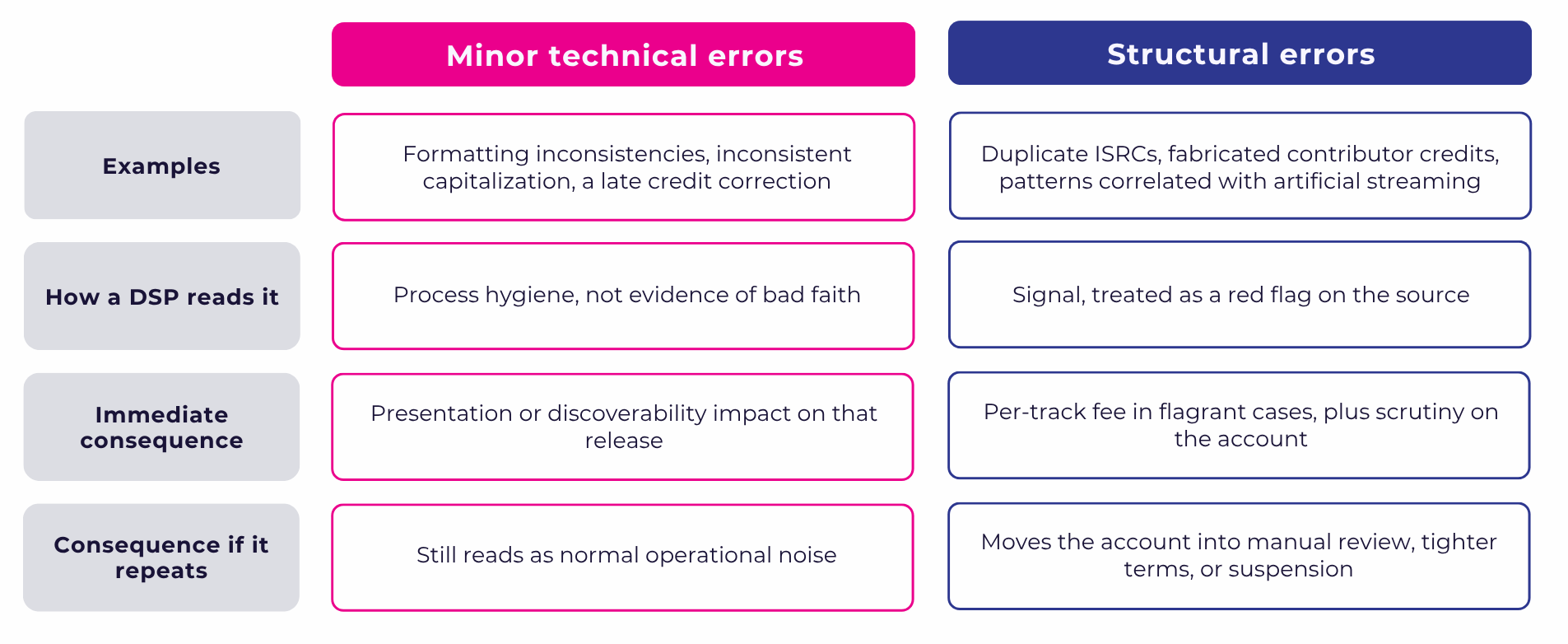
The operational fix is not more QC volume. It is QC segmented by what actually carries relationship risk. That means auditing errors by type, not only by total count, and separating process-hygiene issues such as formatting and timing from structural issues such as duplicate identifiers, credit fabrication, and anomalous streaming signatures in how they get tracked and escalated internally.
It also means tracking those structural errors at the source level, across every DSP a catalog reaches, not just within a single release or a single platform. An error that looks isolated on Spotify might be part of a broader pattern also showing up on Apple Music or Amazon Music. Seen release by release, it looks like noise. Seen source by source and DSP by DSP, it is exactly the signal that triggers the threshold effect described above, well before it becomes visible in a royalty statement.
This is the level at which SonoSuite operates. Its infrastructure tracks metadata and streaming anomalies by source and across DSPs, which means a distributor can see an accumulating pattern forming before it crosses the threshold that turns into DSP friction, instead of finding out only after reviews slow down and flexibility disappears.
The distributors who protect their DSP relationships long term are not the ones with zero errors. They are the ones who know which errors carry structural risk and monitor for the pattern before the DSP does it for them.
If your current QC process can't show you that pattern across your full DSP footprint, that's the gap to close before a DSP closes it for you. See how SonoSuite tracks metadata and streaming anomalies by source, across every DSP in your catalog: Request a demo.
Explore our range of solutions designed to elevate your music businessYour music business is unique, and so are our solutions. We offer tailored options to meet every need, with our team ready to help you find the perfect fit for your growth.udarte a impulsar tu negocio a nivel internacional.


Please complete this form and submit your inquiry. Our team of specialists will review the information you provided to offer you the most suitable solution.
.jpg)
.jpg)
.jpg)